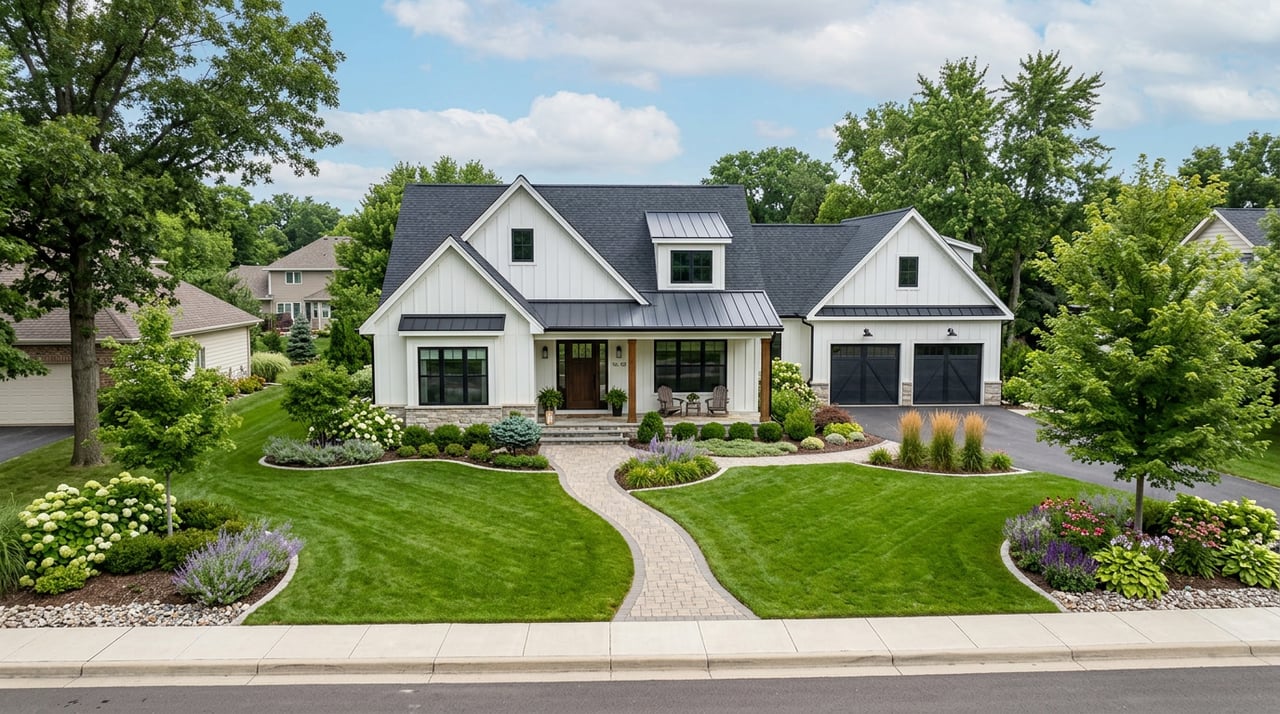
Two buyers toured Costa Mesa the same week this summer. One looked at a 1,850-square-foot updated ranch in Mesa Verde listed near $1.9 million. The other looked at a similarly sized home in College Park, a few miles away, listed under $1.5 million. Same city. Same school district boundaries in the broad sense. Different price by almost half a million dollars.
If you've been comparing the portals, you've probably run into this same confusion. Costa Mesa's citywide median sale price sat at $1.4 million over the three months ending May 2026, according to Redfin, while Zillow's broader home-value estimate put the average closer to $1.35 million as of late June. Neither number tells you what a specific street actually costs, because Costa Mesa isn't one housing market wearing one price tag. It's four or five distinct pockets, and the gap between them tracks something more specific than lot size or renovation quality. It tracks walking distance to one of two retail corridors that are actively rewriting themselves in 2026.
The Median Hides Four Different Markets
Pull the neighborhood-level data and the citywide number stops making sense as a single figure.
| Typical 2026 range | What anchors it | |
|---|---|---|
| Eastside Costa Mesa | Median around $2.1 million over the three months ending May 2026, per Redfin | Walking distance to the 17th Street corridor |
| Mesa Verde | Median around $1.8 million over the three months ending June 2026, per Redfin | Larger lots, Mesa Verde Country Club, Talbert Nature Preserve |
| College Park | Typically $1.35 million to $1.47 million | Mid-century single-family stock, central location, no defining retail draw |
| Westside and Central Costa Mesa | Condos and townhomes commonly in the $800,000s, single-family homes generally $1.3 million to $1.5 million | Proximity to SoBECA's arts and retail campuses |
That spread inside one city limit is the first thing worth sitting with. A buyer comparing Eastside to Westside isn't comparing two versions of the same product at different price points. They're comparing two different lifestyle bets, and the data suggests the bet on walkability is the one paying off fastest.
The Number That Actually Explains the Gap
Here's the detail that doesn't show up on the portals: in Eastside Costa Mesa, the median sale price rose 3.1 percent year over year through May 2026, but the median price per square foot rose 14.9 percent over the same period, according to Redfin. That gap between the two numbers is the tell. If the whole neighborhood were simply appreciating, price and price-per-square-foot would move together. Instead, buyers are paying a steep premium for less space, which points to a specific kind of demand: people who want to be close to something on foot, not people who want the most house for the money.
That something is 17th Street. The commercial stretch anchored by the 17th Street Promenade carries a Walk Score of 94 out of 100, according to CommercialCafe's property data, the kind of score that means groceries, coffee, and dinner are errands you can run without starting a car. Homes within that radius are being bid up on a per-square-foot basis faster than the neighborhood's overall median is climbing, which means the walkability premium itself is widening, not just riding a general market wave.
Mesa Verde tells a different story with a similar conclusion. It has no comparable walkable retail spine. What it has instead is bigger lots, tree-lined streets, and the Santa Ana River Trail on its western edge for anyone who bikes rather than walks. Its median has still climbed, up 4.2 percent year over year through June 2026 per Redfin, but the driver there reads as space and quiet, not proximity to storefronts. Two pockets, two different reasons buyers are willing to pay up, and neither reason is captured by a citywide average.
Two Corridors Are Mid-Rewrite Right Now
If corridor proximity is driving price, then what happens on those corridors this year matters more than it would in a market where retail and residential value moved independently. Both of Costa Mesa's defining walkable strips are in the middle of real change.
On 17th Street, a legacy nightlife anchor at 330 East 17th has gone dark, and in its place a new fast-casual development anchored by CAVA has landed on the same block. It's the first real test of whether a national chain can move onto a street built almost entirely on independent operators, the roster that includes Sidecar Doughnuts, which has held its Eastside spot since 2012, along with Plums Café, Breakfast Republic, The Crack Shack, Eat Chow, and Tres Muchachos Wine Bar & Kitchen. Meanwhile at Paseo 17, the smaller curated center on the same corridor, anchor tenant Milligram expanded its kitchen this past spring while staying open through construction, a sign that operators are reinvesting rather than bailing.
Across town, The LAB Anti-Mall on Bristol Street lost Urban Outfitters as an anchor tenant. Rather than backfill the 12,000-square-foot space with another single chain, ownership is subdividing it into smaller footprints between 650 and 2,600 square feet, including one restaurant space with a patio, a move that leans back toward the property's original small-business identity. Across Bristol at The CAMP, Daydrift reopened its café early in the year, Chafinity Matcha followed, and a Baja-Mexican concept called Maleza was tracking toward a late-summer soft opening as of midyear. Both campuses are editing their tenant mix toward independent, first-and-only concepts rather than chasing scale.
None of this is decorative context. Retail identity on these two corridors is functioning as a leading indicator for the residential streets around them, which is exactly why the Eastside price-per-square-foot number is worth more attention than the median.
What This Actually Means If You're Comparing Pockets
If you're deciding between Costa Mesa pockets, the citywide median is close to useless as a planning number. What matters more is matching your own daily routine to the corridor that supports it, and knowing that corridor's current trajectory.
Eastside makes sense if daily errands on foot matter to you and you're comfortable paying a premium that's actively growing rather than holding steady. Mesa Verde makes sense if you want more square footage and lot size and you're fine driving or biking for groceries and dinner. College Park sits in between, offering single-family character at a more accessible price precisely because it isn't tied to either walkable retail spine. Westside and Central Costa Mesa remain the value entry points, with the tradeoff being a longer drive to daily conveniences even though South Coast Plaza, the county's largest retail destination with more than 230 boutiques and 30 restaurants, sits within the city limits. South Coast Plaza is worth visiting, but it's a regional draw you drive to, not a corridor you walk to for a Tuesday coffee, and that distinction is part of why it hasn't produced the same kind of neighborhood-level pricing premium that 17th Street and the LAB and CAMP corridor have.
If you're weighing a purchase in any of these pockets, the question worth asking isn't just what the home costs today. It's what's happening on the nearest half-mile of retail right now, because in Costa Mesa that half-mile has been moving the price per square foot faster than the median itself.
Frequently Asked Questions
Does a high Walk Score always mean a higher home price in Costa Mesa? Not on its own. Eastside's premium is tied specifically to the retail mix on 17th Street holding its independent character while absorbing new demand. A high Walk Score without an active, well-curated retail corridor behind it wouldn't carry the same weight.
Is Mesa Verde's price driven by the country club? The country club and Talbert Nature Preserve are part of the picture, but the bigger driver appears to be lot size and quiet residential character rather than any single amenity. Mesa Verde's median has grown steadily without the sharp price-per-square-foot spike seen in Eastside.
How quickly do retail changes on a corridor show up in home prices? Based on the pattern in Eastside, where price-per-square-foot growth is already outpacing median growth while the CAVA opening and Milligram expansion are still fresh, the effect shows up within the same year the retail change happens rather than lagging by several years.
Costa Mesa's four pockets are not interchangeable, and the gap between them is only going to get more specific to track as these corridors keep evolving through the rest of 2026. If you want a read on how a particular pocket, or a particular street, fits into that picture before you make an offer, Charlie Price Group can walk you through the comparison block by block.